Acupuncture for Tennis Elbow in San Francisco
Elbow pain when you grip a racket, a club, a climbing hold or your coffee cup? We treat tennis elbow and golfer's elbow with acupuncture, dry needling and hands-on work, plus a plan to get the tendon taking load again.
Sound familiar?
- Pain or burning on the bony point on the outside of the elbow
- Pain on the inside of the elbow, worse when you grip or bend the wrist
- Sharp pain lifting a kettle, a bag or a pan with your palm down
What our patients say
5.0 on Google from 92 reviews
I had a golfers elbow and my coach referred me to Andrew. He has been an amazing acupuncturist and worked on my right elbow, shoulder and arm for a couple of weeks. I have felt so much better just after the first session and going back really helps the blood flow so much better and my right arm, elbow and shoulder feels less tense and more relaxed. Definitely recommend this place, especially for athletes!
Gosh, I'm so happy I found Andrew! Thanks to him, I avoided going down a surgery route for my injury! In June 2022, my left knee started acting up (my best guess is overcompensation for gluteal tendonitis I was treating) but I pushed through to backpack 264 miles on the John Muir Trail. When I finished my trek, my left knee was pretty unhappy and I couldn't even get in and out of my car without feeling like a jigsaw puzzle. I tirelessly saw dozens of providers over the next year - chiropractors, physical therapists, orthopedists, massage therapists, etc. All had their own theories - soleus muscle, calf strain, chronic exertional compartment syndrome, etc. The complexity in my case was that my pain was not in my knee itself - it was on the left side in between my knee cap and calf. Despite my knee MRI showing meniscus tears, inflammation, tendonosis, etc. the doctors insisted we treat the symptoms, not the MRIs. So, I got a calf MRI, hip MRI, and an EMG, all of which were negative. Then, one doctor recommended oral Prednisone, and he told me I should see results better than Advil for pain management. It did nothing. It wasn't until I was finally referred to one doctor who noticed something in my knee MRI and caught that there is excess fluid in my proximal tibiofibular joint (PBTJ), and that area tracks with where I feel my pain. To test his suspicion diagnostically, he recommended an ultrasound-guided cortisone injection in my PBTJ to see if that reduced my pain. The pain did decrease (which was good), but it wasn't gone. The doctors informed me issues concerning the PBTJ are rare, and that they needed to refer me to one of the only specialists in the country for this. That specialist happened to be in Minnesota, and when I checked his website, he was only seeing patients for surgery. I did not want surgery. I felt completely defeated, unsure where to go next. In May, I was recommended by someone who also had a challenging journey with injuries (and was able to return to running and hiking) to try acupuncture. I was surprised, since I had not considered Eastern Medicine before for a sports injury. The person specifically recommended I search for an acupuncturist who specializes in athletes, and that led me to find "Acupuncture for Athletics." :) My first appointment with Andrew was May 30, and he patiently listened to my whole ordeal and reviewed all of the documentation I brought (MRIs, doctor's notes, etc). He assured me he treats the root cause, which I appreciated because I did not want to do a band-aid fix only for this to return again, and that he has hope I can feel better. We started off with cupping along my left leg to encourage the inflammation to dissipate, and then we did needles in my leg. Oof, I remember one session when Andrew placed a needle near my PBTJ - I screamed SO loudly lol. But once all of the needles were in, it slowly felt like a meditative experience, and I was able to relax into it. Over my 7 sessions with Andrew, I began to notice the needles felt less painful. In the beginning, I remember feeling the pain just in walking over to Andrew's office. By the 6th session, I realized I wasn't thinking about my pain anymore. I did one more session to be sure, and I was in disbelief that I actually felt pain-free! We decided to go a month testing how the pain fared without regular sessions, and so far so good! The pain flares here and there, but in a MUCH less capacity than before. Throughout this whole process, Andrew was kind, patient, and determined. He was committed to solving the underlying issue, and he was flexible and accommodating to me - whether I wanted to address my left knee or start tackling similar pain that was creeping up on my right knee. Had it not been for Andrew, I would have likely chased surgery because I was running out of ideas. I appreciate you, Andrew! If you're nearing your wits' end with a chronic injury, please go see Andrew and give it a good ~5 sessions if you can. Wishing everyone out there good luck on their chronic pain journeys! You got this!
Andrew introduced me to a form of healing which, after years of competitive long distance running and many injuries, I am more than thankful to have discovered! My latest injury, a small tear in my left hamstring, sidelined me for a number of months. After trying rest, physical therapy and anti-inflammatories with little results, I finally met Andrew. His approach from the very beginning was completely methodical, precise and extremely professional. Right away the pain eased, and I felt my body finally respond to treatment. Andrew was instrumental in healing my hamstring, and I trust that his acupuncture/massage techniques will keep me healthy and, importantly, keep me running for many decades and miles.
I came to Andrew after nearly six excruciating months of not being able to run. I had a seemingly minor Achilles tendon injury that simply refused to heal, defying every modality I tried. I hoped Andrew, a specialist in sports injuries, could break the deadlock. The simple answer is that in three visits, I was running again, hardly able to believe my good fortune. The more complicated answer runs deeper. Andrew’s work doesn’t just address physical injury; he works on spiritual and emotional injury and stress too. I didn’t realize that my physical injury was bound up with emotional trauma, but he did, and he figured out how to disentangle them so the healing process could start. The process can be painful; emotional injuries that have lodged in your body have to work their way out through muscle and bone, like a physical illness. But it’s also both profound and unexpected. As another of Andrew’s clients said, he is a true healer.
Andrew Castellanos has helped my Achilles tendinosis and tendinitis with acupuncture, not only getting the swelling down, but also massaging the area after. His therapeutic work has enabled me to continue dancing at a high level without having to take a break, so I’m able to dance with injury due to the therapeutic work that Andrew does.
Andrew treated me over a period of about two years for hip and shoulder problems, and he was tremendously helpful. I was impressed with his knowledge and skill, not to mention wonderful “bedside manner” and especially his enthusiasm for staying current in his field.
I loved coming to Andrew. He was a lifesaver in helping me through some back issues when I was pregnant with my first child. A lovely, warm place and Andrew is amazing!!!!
Andrew is a fantastic alternative and addition to physical therapy. He quickly understands your condition and treats it effectively.
I’ve always wanted to be able to demonstrate clearly to professional dancers when giving them corrections or setting ballets. However, without the level of daily physical preparation that my body was used to when I danced, my body now has moments of rebellion that, however careful I am, need the assistance of experts to ensure I can do my job fully. Andrew’s combination of acupuncture and soft tissue work always made a significant difference to my mobility, helping me undertake my role in the studio at a level of physicality such that I’m not confined to the minimum level of demonstration. With his level of experience with dancers it was always easy to discuss problematic muscles and joints, and reassuring that he ‘got’ what was going on and what was required to improve the situation efficiently and effectively.
Andrew’s massage and acupuncture techniques have seen me successfully through back-to-back marathons seven weeks apart, plus two active pregnancies and a record-breaking racing season in between. He is a veritable genius in his field — a true healer.
As a professional dancer, I rely heavily on Andrew throughout the performance season to literally fix me in order to get me back onstage. I have chronic problems with my knee and my shoulder, and the combination of acupuncture with electric stimulation and heat has been tremendously helpful. Andrew only needs five minutes to find exactly where he needs to work, and the results are fantastic. His acupuncture work is also gentle, and doesn’t leave me sore the next day — in fact, it’s one of the only therapies I feel comfortable receiving right before a show. Andrew does great deep tissue work as well, and he is very responsive and attentive as a therapist. I’d highly recommend him to dancers, athletes and non-dancers alike.
In our career it is very important to stay physically healthy, because our dance career is very short. We rehearse, work out every single day, and very often, because of the physical pressure from practicing so hard, we get injuries and surgery. My story is about my back, foot and wrist. I joined San Francisco Ballet a year ago. The first day of work, during ballet class, I hurt my back. I have had problems before with my wrist, and sadly, later on with the tough season, my foot got hurt. Luckily, I was recommended to Andrew Castellanos. I started with a few visits a month, and quickly saw results, so I made sure I finished my treatments. Thanks to Andrew, I was able to finish my successful season here. Now I have to spread the word…
Does this sound like you?
Tennis elbow hurts on the outside of the elbow and golfer's elbow on the inside. Both are tendon problems driven by gripping, and these are the usual signs.
If several sound familiar, an assessment will confirm which tendon is involved and what's been overloading it.
- Pain or burning on the bony point on the outside of the elbow
- Pain on the inside of the elbow, worse when you grip or bend the wrist
- Sharp pain lifting a kettle, a bag or a pan with your palm down
- A weaker grip, or dropping things more than usual
- Pain that spreads into the forearm toward the wrist
- Stiffness and ache first thing in the morning
What's going on in your elbow
The muscles that grip and move your wrist all anchor on two small bony points at the elbow. The ones that lift the wrist back attach on the outside, and the ones that curl it forward attach on the inside. Every grip pulls on those anchor points.
When gripping outpaces the tendon's ability to recover, it stops healing well and starts to hurt. Doctors now often call it epicondylalgia (elbow pain) rather than epicondylitis, because the problem is more wear and poor healing than true inflammation. It usually builds slowly over weeks.
Despite the names, most people with tennis elbow don't play tennis. The American Academy of Orthopaedic Surgeons notes it's most common between ages 30 and 50, and painters, plumbers, carpenters and cooks are all at higher risk.
Common causes
- A new racket, more matches or a switch to pickleball
- Hard climbing sessions, especially crimps and pinches
- Long hours on a mouse and keyboard
- Lifting, carrying or using tools at work
- A golf swing that hits the ground hard, or extra range sessions
- Weakness or stiffness further up, in the shoulder or upper back
Tennis elbow or golfer's elbow?
Same idea, opposite sides of the joint. Knowing which tendon is involved tells us which muscles to treat and which movements to change.
| Compared on | Tennis elbow (lateral) | Golfer's elbow (medial) |
|---|---|---|
| Where it hurts | The outside of the elbow, spreading down the back of the forearm | The inside of the elbow, spreading down the palm side of the forearm |
| What makes it worse | Gripping with the palm down, lifting the wrist back, a backhand | Curling the wrist, gripping hard, a forehand, a golf swing, pulling on holds |
| Who we often see it in | Tennis and pickleball players, desk workers, trades | Golfers, climbers, throwers and lifters |
| Watch for | Pain that also comes from the neck | Tingling in the ring and little fingers, which can mean the ulnar nerve is involved |
| Where we focus | The wrist extensors, the forearm and the shoulder above | The wrist flexors, grip muscles and the shoulder above |
Good news on the outlook
Most elbow tendon pain gets better without surgery. The AAOS reports that about 80 to 95% of people with tennis elbow do well with nonsurgical care, and Cleveland Clinic says the same of golfer's elbow. The catch is time: stubborn cases can take six to 12 months, which is why it pays to treat it early.
Who gets elbow pain
Rackets, clubs, climbing walls and keyboards all load the same tendons. In a typical week we see it in a mix of athletes and people who use their hands all day.
People we see most
Related problems we treat
- Wrist pain and carpal tunnel
- Shoulder pain in overhead athletes
- Neck pain that refers into the arm
- Forearm tightness and grip fatigue
- Repetitive strain from work
How we treat tennis and golfer's elbow
We calm the sore tendon, release the tight forearm muscles pulling on it and check what's happening further up the arm. Most visits combine several of these.

- Sports acupuncturePoints around the elbow, forearm and shoulder to ease pain and help the tendon recover.
- Dry needlingInto trigger points in the forearm muscles that keep tugging on the tendon.
- CuppingSmall cups along the forearm to loosen tight, overworked tissue.
- Cold laserLow-level laser over the sore tendon, commonly used for slow-healing soft tissue.
- Sports massageSoft tissue work through the forearm, upper arm and shoulder.
Who performs dry needling in California?
In California, dry needling is performed by licensed acupuncturists. Physical therapists in California are not currently authorized to perform dry needling. All of our practitioners are licensed acupuncturists in California.
What the research says
Tennis elbow is one of the better-studied uses of acupuncture. A 2004 review of six trials found strong evidence that acupuncture relieves outer elbow pain in the short term, and five of the six found it beat the comparison treatment.
A larger 2014 review of 19 trials found that real acupuncture worked better than sham. For dry needling, a 2020 review of seven trials with 320 patients found it reduced pain and disability in the short term.
Steroid injections are worth a mention because many people are offered one. In a 2013 trial in JAMA, people who had an injection were less likely to have recovered at one year than those given a placebo injection (83% versus 96%), and far more likely to have a recurrence (54% versus 12%).
Golfer's elbow involves the same kind of tendon problem on the inside of the joint, so we use a similar approach. Curious how it works? Read what happens in an acupuncture session.
The short version
- Reviews support it for short-term tennis elbow pain
- Dry needling has also been found to ease pain and disability
- Best results come with gradual strengthening
- Results vary, and stubborn tendons take time
Your first visit and your plan
Plan on about an hour for your first visit. How many sessions you'll need varies, and we'll give you an honest estimate after your assessment.
Assess
We ask about your sport, your work and your setup, then test grip, wrist and elbow movement and check the neck and shoulder for a hidden contributor.
Treat
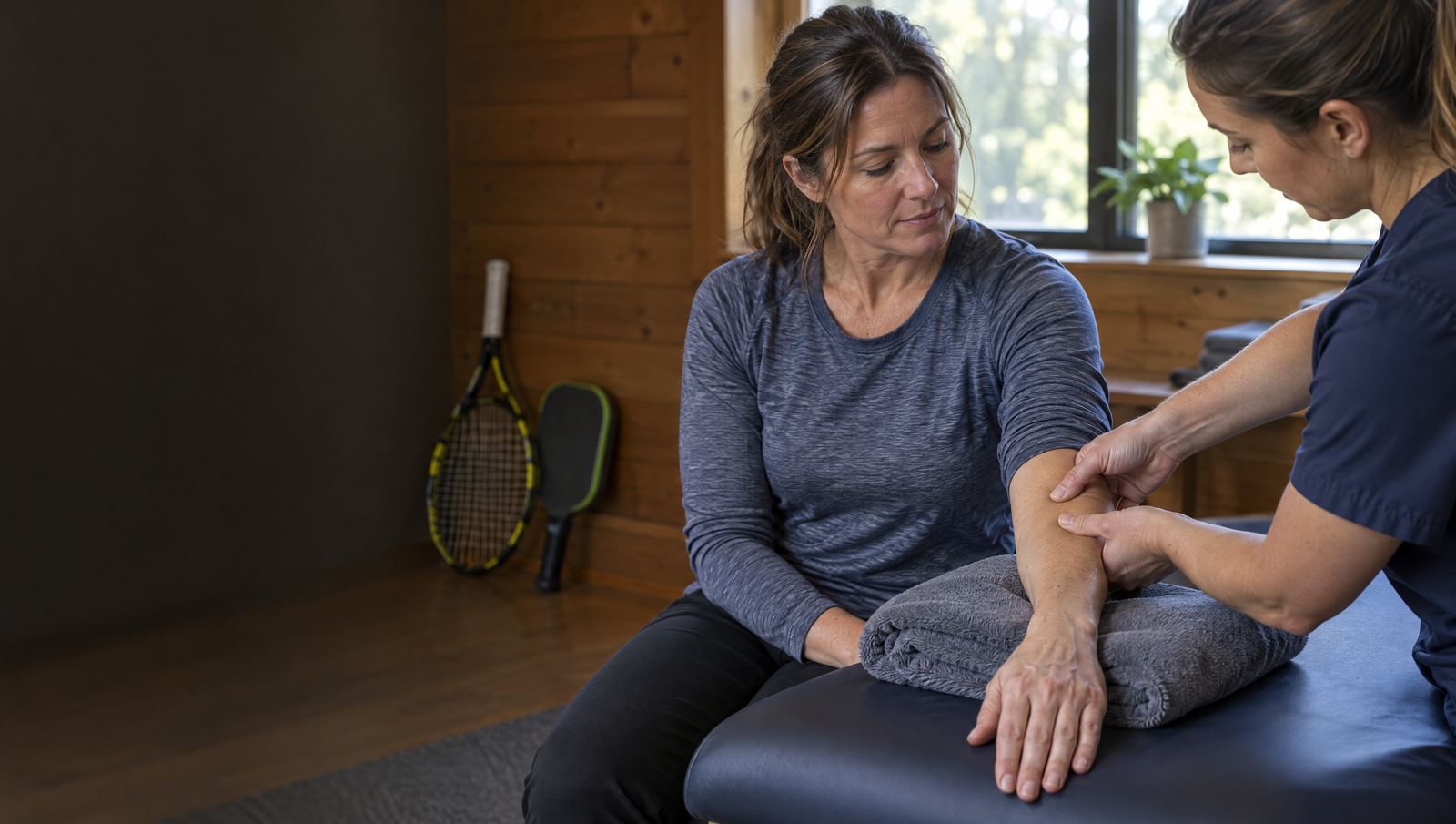
You'll sit or lie with the arm supported on a towel. Needles go into the forearm and around the elbow, often with points up toward the shoulder.
Afterwards
Gripping often feels easier the same day. The forearm may feel tender or heavy for a day or so, like after a hard workout.
Build it back
We give you simple grip and wrist strengthening to do at home, adjust it as the pain settles, and space visits out as the tendon tolerates more.
When to see a doctor first
Most elbow pain from gripping is a tendon problem we can help with. A sudden injury is different: a pop at the front of the elbow when lifting something heavy can be a torn biceps tendon, which needs a doctor's assessment promptly.
Throwers with pain on the inner elbow while throwing should also see a sports medicine physician, since the ligament there can be injured. If any of these signs apply, please see your doctor first. We're happy to work alongside them.
See a physician if you have
- A pop, sudden pain or bruising after a lift or fall
- An elbow you can't fully bend or straighten
- A red, hot, swollen elbow or a fever
- Numbness or weakness in the hand or fingers
- Pain that keeps getting worse despite rest
Who'll treat you
Three California-licensed acupuncturists trained in Traditional Chinese Medicine, who treat tendon problems every week. Andrew Castellanos has more than 25 years with athletes, from USF Athletics to the San Francisco Ballet. We pair needling with hands-on work and a plan to get the tendon taking load again.

Andrew Castellanos
L.Ac, CST · Clinic owner
Tennis and golfer's elbow in players, climbers and desk workers.
- Tennis elbow is one of the injuries he treats most
- Cold laser and dry needling for stubborn tendons
- Soft tissue mobilization for the forearm
Ali Hakimi
L.Ac
Local acupuncture and cupping for grip pain and tendon recovery.
- Local acupuncture for injury recovery and pain reduction
- Extensive knowledge of classical herbal medicine
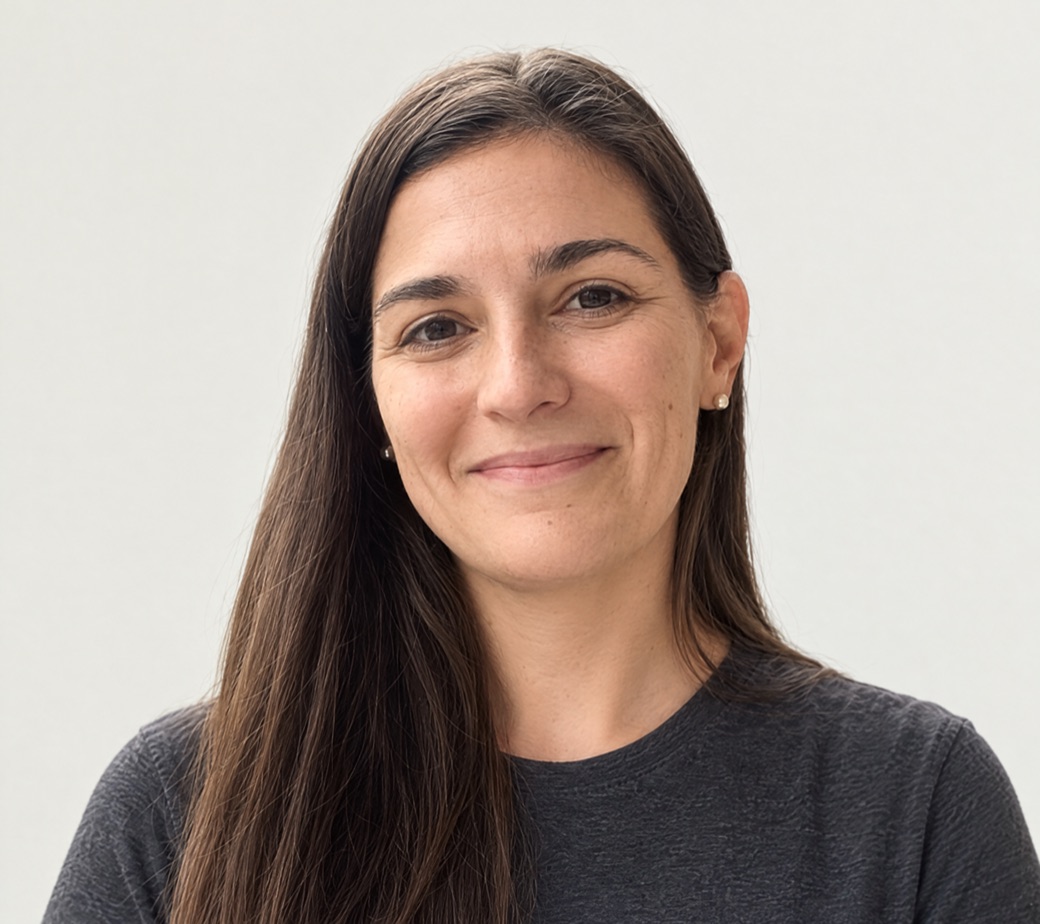
Suzanne Lange
DACM, L.Ac, CMT
Elbow and forearm pain treated with acupuncture and trigger point work.
- Whitfield Reaves Sports Medicine Apprenticeship
- Certified massage therapist with myofascial training
- 20+ years of clinical experience
Pricing and booking
Elbow treatment happens in a standard session, using whatever mix of acupuncture, dry needling, cupping, cold laser and massage suits your arm. There's no separate package.
We don't bill insurance, but we give you a superbill for possible out-of-network reimbursement, and we take HSA and FSA cards and all credit cards. Our clinic sits on Webster Street, close by for anyone after acupuncture in Cow Hollow.
Appointments
- 60-min initial acupuncture & assessment
- $225
- 45-min acupuncture follow-up
- $195
- 60-min acupuncture/massage combo
- $225
- 75-min acupuncture/massage combo
- $265
- 90-min acupuncture/massage combo
- $300
Tennis and golfer's elbow FAQ
Does acupuncture work for tennis elbow?
Research suggests it can help, especially for short-term pain relief. Reviews of the trials have found acupuncture eases outer elbow pain and works better than sham treatment. Results vary from person to person, and it works best alongside gradual strengthening. We'll estimate how many sessions you may need after your assessment.
Can acupuncture help golfer's elbow too?
Yes, we treat it the same way, focusing on the muscles on the inside of the forearm. Golfer's elbow is the same kind of tendon problem on the other side of the joint, and in our experience it responds to a similar approach.
How many sessions will I need?
It varies with how long you've had it and how much you're still loading it. A recent flare often settles faster than pain you've carried for a year. We'll give you an estimate after your first assessment and adjust as we go, rather than selling a package.
Should I rest it completely?
Usually not. Complete rest can leave the tendon weaker when you go back. Ease off the movements that cause sharp pain, keep the arm moving, and start gentle strengthening, which is the backbone of recovery. We'll show you where to begin.
Can I keep playing tennis, pickleball, golf or climbing?
Often, with changes. You might shorten sessions, drop the strokes or holds that hurt, or look at your grip size and equipment for a few weeks. We'll help you decide what's fine to keep and how to build back to full play.
Should I get a steroid injection instead?
That's a decision for you and your doctor. Injections can ease pain quickly, but a 2013 trial found people who had one were less likely to have recovered at one year and more likely to relapse than those given a placebo injection. Many people prefer to try conservative care first.
Does a brace or strap help?
A forearm strap worn just below the elbow can take some strain off the tendon during activity, and many people find it helps. It's a support, not a fix, so we use it alongside treatment and strengthening rather than instead of them.
Does dry needling in the forearm hurt?
You may feel a deep ache or a quick twitch as the needle reaches a tight spot, which passes in seconds. Afterwards the forearm can feel sore for a day or two. Regular acupuncture needles are very thin, and most people find them barely noticeable.
Where can I find acupuncture for tennis elbow in the Marina?
Our clinic is at 2920 Webster Street, on the Cow Hollow side of the Marina. Andrew Castellanos treats tennis elbow and golfer's elbow with acupuncture, dry needling and hands-on work. He then gives you a plan to get the tendon taking load again, so you can get back to your racket, club or climbing wall.
Do you see patients from Marin, Oakland or Berkeley?
Yes, some of our patients cross the Bay to see us. If you're driving, the Union Laguna Garage at 1910 Union Street and the meters on Union Street are the simplest options. Ali sees patients on Saturdays, which can fit around a weekend match.
References
- Trinh KV, et al. Acupuncture for the alleviation of lateral epicondyle pain: a systematic review. Rheumatology (Oxford). 2004.
- Gadau M, et al. Acupuncture and moxibustion for lateral elbow pain: a systematic review of randomized controlled trials. BMC Complementary and Alternative Medicine. 2014.
- Navarro-Santana MJ, et al. Effects of trigger point dry needling on lateral epicondylalgia of musculoskeletal origin: a systematic review and meta-analysis. Clinical Rehabilitation. 2020.
- Coombes BK, et al. Effect of corticosteroid injection, physiotherapy, or both on clinical outcomes in patients with unilateral lateral epicondylalgia: a randomized controlled trial. JAMA. 2013.
- American Academy of Orthopaedic Surgeons. Tennis Elbow (Lateral Epicondylitis). OrthoInfo.
- Cleveland Clinic. Golfer's Elbow (Medial Epicondylitis): Symptoms and Treatment.
Ready to grip without wincing?
Book an assessment at our Cow Hollow clinic, or call us to talk it through first.
Visit us in Cow Hollow
2920 Webster Street, between Union and Filbert. A short walk from the Marina, Pacific Heights and the Presidio.
Address
Acupuncture for Athletics2920 Webster Street
San Francisco, CA 94123 Gate code: in your booking confirmation email
Hours
- Every day
- 7:30am – 9:00pm