Sports Massage in San Francisco
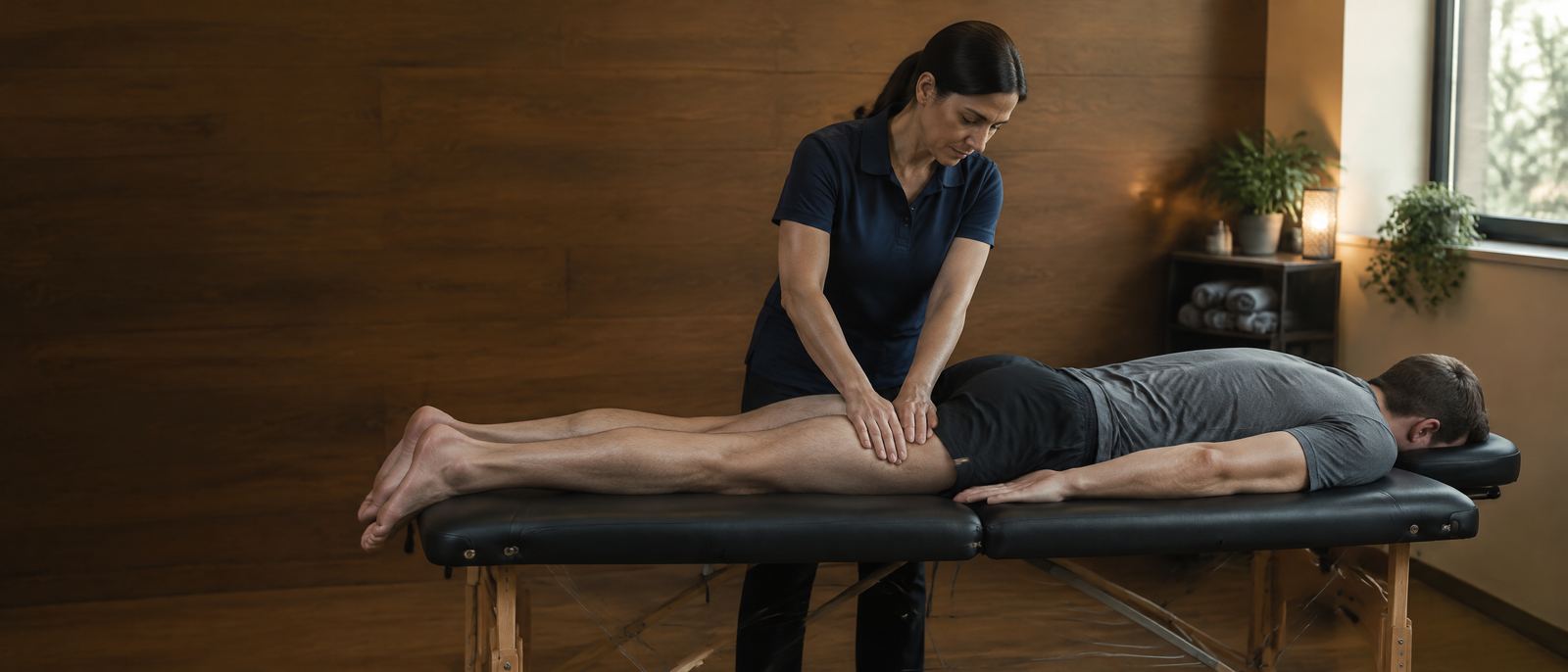
Assessment-led sports massage from all three of our practitioners, licensed acupuncturists who treat athletes every day at our Cow Hollow clinic.
Rated 5.0 on GoogleLicensed acupuncturists
- Performed by
- Andrew, Suzanne or Ali
- Best for
- Tight, overworked muscle and training recovery
- How it feels
- Firm, focused pressure, adjusted to you
- Pairs with
- Cupping and dry needling

What our patients say
5.0 on Google from 92 reviews
Andrew applies his knowledge of the body and expert techniques to address affected muscles both for maintenance during training and related to injury. His combination of acupuncture and massage helps to open up areas and find the place to target. I have seen Andrew in the past for recovery post concussion and most recently for routine maintenance while training at a high level for my next marathon. I highly recommend Andrew and am lucky to have him as a part of my support team to stay healthy! - Katie Hynes, competitive runner -
Andrew introduced me to a form of healing which, after years of competitive long distance running and many injuries, I am more than thankful to have discovered! My latest injury, a small tear in my left hamstring, sidelined me for a number of months. After trying rest, physical therapy and anti-inflammatories with little results, I finally met Andrew. His approach from the very beginning was completely methodical, precise and extremely professional. Right away the pain eased, and I felt my body finally respond to treatment. Andrew was instrumental in healing my hamstring, and I trust that his acupuncture/massage techniques will keep me healthy and, importantly, keep me running for many decades and miles.
I could not recommend Andrew enough! He has so much knowledge on the human body and can figure out quickly what areas need work. I went in with major back pain that kept me from lifting weights or running, and after a few sessions I am pain free.
As an avid runner who is always training for an endurance race my body has a tendency to break down. Andrew is a legit magician. He’s able to get to the root off the problem quickly and I often don’t miss a beat with regards to my training. Marathon prep would not be possible otherwise.
I’ve always wanted to be able to demonstrate clearly to professional dancers when giving them corrections or setting ballets. However, without the level of daily physical preparation that my body was used to when I danced, my body now has moments of rebellion that, however careful I am, need the assistance of experts to ensure I can do my job fully. Andrew’s combination of acupuncture and soft tissue work always made a significant difference to my mobility, helping me undertake my role in the studio at a level of physicality such that I’m not confined to the minimum level of demonstration. With his level of experience with dancers it was always easy to discuss problematic muscles and joints, and reassuring that he ‘got’ what was going on and what was required to improve the situation efficiently and effectively.
Andrew’s massage and acupuncture techniques have seen me successfully through back-to-back marathons seven weeks apart, plus two active pregnancies and a record-breaking racing season in between. He is a veritable genius in his field — a true healer.
As a professional dancer, I rely heavily on Andrew throughout the performance season to literally fix me in order to get me back onstage. I have chronic problems with my knee and my shoulder, and the combination of acupuncture with electric stimulation and heat has been tremendously helpful. Andrew only needs five minutes to find exactly where he needs to work, and the results are fantastic. His acupuncture work is also gentle, and doesn’t leave me sore the next day — in fact, it’s one of the only therapies I feel comfortable receiving right before a show. Andrew does great deep tissue work as well, and he is very responsive and attentive as a therapist. I’d highly recommend him to dancers, athletes and non-dancers alike.
Gosh, I'm so happy I found Andrew! Thanks to him, I avoided going down a surgery route for my injury! In June 2022, my left knee started acting up (my best guess is overcompensation for gluteal tendonitis I was treating) but I pushed through to backpack 264 miles on the John Muir Trail. When I finished my trek, my left knee was pretty unhappy and I couldn't even get in and out of my car without feeling like a jigsaw puzzle. I tirelessly saw dozens of providers over the next year - chiropractors, physical therapists, orthopedists, massage therapists, etc. All had their own theories - soleus muscle, calf strain, chronic exertional compartment syndrome, etc. The complexity in my case was that my pain was not in my knee itself - it was on the left side in between my knee cap and calf. Despite my knee MRI showing meniscus tears, inflammation, tendonosis, etc. the doctors insisted we treat the symptoms, not the MRIs. So, I got a calf MRI, hip MRI, and an EMG, all of which were negative. Then, one doctor recommended oral Prednisone, and he told me I should see results better than Advil for pain management. It did nothing. It wasn't until I was finally referred to one doctor who noticed something in my knee MRI and caught that there is excess fluid in my proximal tibiofibular joint (PBTJ), and that area tracks with where I feel my pain. To test his suspicion diagnostically, he recommended an ultrasound-guided cortisone injection in my PBTJ to see if that reduced my pain. The pain did decrease (which was good), but it wasn't gone. The doctors informed me issues concerning the PBTJ are rare, and that they needed to refer me to one of the only specialists in the country for this. That specialist happened to be in Minnesota, and when I checked his website, he was only seeing patients for surgery. I did not want surgery. I felt completely defeated, unsure where to go next. In May, I was recommended by someone who also had a challenging journey with injuries (and was able to return to running and hiking) to try acupuncture. I was surprised, since I had not considered Eastern Medicine before for a sports injury. The person specifically recommended I search for an acupuncturist who specializes in athletes, and that led me to find "Acupuncture for Athletics." :) My first appointment with Andrew was May 30, and he patiently listened to my whole ordeal and reviewed all of the documentation I brought (MRIs, doctor's notes, etc). He assured me he treats the root cause, which I appreciated because I did not want to do a band-aid fix only for this to return again, and that he has hope I can feel better. We started off with cupping along my left leg to encourage the inflammation to dissipate, and then we did needles in my leg. Oof, I remember one session when Andrew placed a needle near my PBTJ - I screamed SO loudly lol. But once all of the needles were in, it slowly felt like a meditative experience, and I was able to relax into it. Over my 7 sessions with Andrew, I began to notice the needles felt less painful. In the beginning, I remember feeling the pain just in walking over to Andrew's office. By the 6th session, I realized I wasn't thinking about my pain anymore. I did one more session to be sure, and I was in disbelief that I actually felt pain-free! We decided to go a month testing how the pain fared without regular sessions, and so far so good! The pain flares here and there, but in a MUCH less capacity than before. Throughout this whole process, Andrew was kind, patient, and determined. He was committed to solving the underlying issue, and he was flexible and accommodating to me - whether I wanted to address my left knee or start tackling similar pain that was creeping up on my right knee. Had it not been for Andrew, I would have likely chased surgery because I was running out of ideas. I appreciate you, Andrew! If you're nearing your wits' end with a chronic injury, please go see Andrew and give it a good ~5 sessions if you can. Wishing everyone out there good luck on their chronic pain journeys! You got this!
I would strongly (strongly!) recommend Acupuncture for Athletics for both athletes and non-athletes alike. Not only does Andrew help with injury recovery, pain management, and stress relief, but he creates a relaxing and positive environment that enhances the work that he does and leads you to feel better both physically and mentally after each visit. And beyond acupuncture and massage, Andrew goes the extra mile to provide guidance on how to address specific pain-points and injuries, or to simply ensure that you are feeling and performing your best. Again, I can't recommend Acupuncture for Athletics enough!
Andrew is the best. I’m a professional ballerina and his treatments helped me come back from a broken foot. When you see Andrew - you’re comforted by his knowledge, expertise, & strategy based treatment. Plus the clinic is so relaxing and warm. I have complete trust that he will help my aches and pains and keep me dancing for a long time.
There’s no one I trust more than Andrew to support my kids in their healing process if they’ve had a sports-related injury. As elite athletes, it’s so important that their knees, ankles and shoulders are well taken care of, and Andrew is our go-to for treatment of pain or injury and also guidance for best practices outside the treatment room to further help healing along. My daughter recently rolled her ankle and was ready for a painfully prolonged healing process when we took her into to see Andrew for a couple treatments before a tournament weekend. With his help, her recovery was amazing, allowing her to feel confident on her ankle. Thanks to Andrew, she was healthy enough to play without pain or exacerbating the injury. We are very grateful to have Andrew on speed dial when these types of injuries occur!
Andrew is a fantastic alternative and addition to physical therapy. He quickly understands your condition and treats it effectively.
Massage with a plan behind it, not just pressure.
Sports massage in San Francisco should start with a question: what are you training for, and what's getting in the way? At Acupuncture for Athletics, all three of our practitioners give sports massage: clinic owner Andrew Castellanos, L.Ac, CST, Suzanne Lange, DACM, L.Ac, CMT, a California certified massage therapist, and Ali Hakimi, L.Ac. Each is a licensed acupuncturist, so your massage can sit inside a wider plan for the injury.
We look at how you move first, then work on the tissue that's actually limiting you: hips, hamstrings, calves, backs and shoulders. Because we're a sports acupuncture clinic, massage can sit alongside acupuncture, cupping or dry needling in one visit, at 2920 Webster Street in Cow Hollow.
Why Work with Us
We're not just for athletes, but for everyone wanting more movement and less pain in their life.
Built around your life
We start with how you move, then treat the injury with a plan to get you back to training, work and everyday life.
Excellence in one visit
Acupuncture, dry needling, cupping, cold laser and sports massage from the same licensed team, so you're not bouncing between clinics.

Trusted by professionals
Andrew and team have treated athletes for USF, the San Francisco Ballet, LINES Ballet and MLB spring training. Our patients rate us 5.0 on Google.
What is sports massage?
Massage therapy means working the body's soft tissues (muscle, fascia and tendon) with the hands. Sports massage uses those skills with a training goal in mind. It focuses on the areas your sport loads most, and it's timed around your training and races rather than booked as a general treat.
A session here usually draws on several techniques: deep tissue work into the deeper muscle layers, myofascial release to ease restricted fascia, trigger point therapy on knots that refer pain elsewhere, and assisted stretching and joint mobilization to take your hips, ankles and shoulders through their range while the tissue is warm.
Pressure is set for your tissue on the day. Firm work is often useful, but it should never be so painful that you brace against it.

Sports massage vs deep tissue massage
People use the two terms interchangeably, but they aren't the same thing. Deep tissue is a technique. Sports massage is a plan that often uses it.
| Compared on | Sports massage | Deep tissue massage |
|---|---|---|
| Main goal | Recover from training, prepare for an event or settle a specific problem | Ease long-standing tension in the deeper layers of muscle |
| Focus | The one to three areas your sport loads most | Often a broader, full-body session |
| Techniques | Deep tissue, myofascial release, trigger points, stretching and joint mobilization | Slow, firm strokes and friction |
| Pressure | Changes with timing: lighter before an event, deeper in a recovery block | Consistently firm to deep |
| Timing | Planned around your training and race calendar | Booked whenever tension builds up |
| Best for | Athletes and active people with a goal or a niggle | Stubborn tightness from work, posture or stress |
Not sure which you need?
If you train regularly and something is holding you back, sports massage is usually the better fit. If you mainly want to work out deep, long-standing tension, tell us and we'll set the session up with a deep tissue focus. Either way, "deep" should never mean unbearable.
What the research says
Massage may help you recover from hard training. A 2020 review of 29 randomized studies with 1,012 participants found that sports massage improved flexibility and eased delayed-onset muscle soreness (DOMS).
Soreness is where the evidence is strongest. A 2017 meta-analysis of 11 trials found that massage after hard exercise reduced soreness, with the biggest effect 48 to 72 hours later, and lowered creatine kinase, a marker of muscle damage. A 2018 analysis of 99 studies on recovery methods concluded that massage looked like the most effective technique for reducing DOMS and perceived fatigue.
Outside sport, the National Center for Complementary and Integrative Health reports that massage may help neck and shoulder pain in the short term. We pair it with a plan built around your training, so each session works toward a goal.
What athletes often notice
- Less soreness in the days after hard sessions
- Easier range of motion in hips, ankles and shoulders
- Tight spots that finally let go
- Feeling looser and readier to train
Who it's for
Anyone who trains regularly, from marathoners to people who spend the week at a desk and the weekend on a bike.
Athletes we see most
Commonly used for
- Running injuries and heavy mileage
- Calf, Achilles and plantar fascia tightness
- Tight hips, hip flexors and glutes
- Hamstring and quad tightness
- IT band and outer knee tension
- Low back stiffness after rides and lifting
- Neck and shoulder tension from desk work plus training
- Forearm and elbow overuse from climbing, tennis and golf
- Race preparation and post-race recovery
Pairing sports massage with other care
Sports massage works well on its own. When a problem needs more than hands alone, it also pairs with the other treatments we offer, planned around the same goal.
Massage pairs well with cupping for tight backs, glutes and hamstrings, and with trigger-point dry needling for knots that hands alone can't reach. New to needles? Here's how we approach sports acupuncture.
Want acupuncture and massage together?
That's our acupuncture + massage combo, a different treatment: Andrew starts with acupuncture to calm the nervous system, then gives a targeted massage on a relaxed body.
Your first sports massage visit
What happens, what it feels like, and how it fits around your training.
Talk it through
We ask what you're training for, what's coming up, where it hurts, and anything that changes how we work, like pregnancy, recent surgery or blood thinners.
Movement check
A quick look at a squat, a hip hinge or an overhead reach shows us where to work, so we treat the cause and not just the sore spot.
Focused treatment
Hands-on work on one to three areas, with pressure adjusted as we go. Athletic clothing is fine, and you'll be draped for any work on bare skin.
Afterwards
Drink water and keep moving gently. Mild soreness for 24-48 hours after deep work is normal. How often to come back varies, and we'll suggest a plan.
Timing massage around your training
Before a race, lighter is better. Save deep work for several days out so there's no lingering soreness on the start line, and keep anything closer to the day short, gentle and focused on mobility.
After a race or a big block, let the worst of the soreness peak first, usually a day or two, then book recovery work. That lines up with the 48 to 72 hour window where the research shows the biggest drop in soreness.
During a training cycle, a regular rhythm helps more than an occasional rescue session. How often depends on your load and goals.
Tell us first if you have
- A recent injury, swelling or a suspected tear
- Recent surgery or a history of blood clots
- Blood thinners or a bleeding disorder
- A pregnancy (Suzanne also specializes in pregnancy care)
- Rashes, infection or broken skin in the area
Serious side effects from massage are rare, but deep work isn't right for everyone. If something needs a doctor first, we'll tell you.
Who gives your sports massage
All three of our practitioners give sports massage, and all three are California-licensed acupuncturists. If your massage turns up something that needs acupuncture or a different approach, the right person is in the same clinic.
Andrew Castellanos, L.Ac, CST, the clinic owner, has more than 25 years of experience with athletes. His hands-on work includes deep tissue sports massage, myofascial release, soft tissue mobilization and neuromuscular reeducation.
Suzanne Lange, DACM, L.Ac, CMT, is a certified massage therapist with more than 20 years of clinical experience, trained in myofascial and trigger point therapy. In California, massage therapists are certified rather than licensed, through the California Massage Therapy Council. She also works in pregnancy and postpartum care, so pregnant athletes get the right positioning and pressure.
Ali Hakimi, L.Ac, pairs hands-on work with local acupuncture for injury recovery and pain reduction, and diet and lifestyle advice aimed at performance. Meet the whole team.
Our team at a glance
- Three licensed acupuncturists who all give sports massage
- Deep tissue, myofascial and trigger point work
- A certified massage therapist (Suzanne, CMT)
- Appointments 7:30am to 9pm, seven days a week
Pricing and booking
A 45-minute sports massage is $195. Book online and choose the appointment that fits, or call us and we'll find the right session and time. Want acupuncture and massage together? That's our acupuncture + massage combo.
We don't bill insurance, but we provide a superbill you can submit for possible out-of-network reimbursement. We accept HSA and FSA cards and all credit cards, and gift certificates are available. Planning a bigger recovery block? See all our services.
Appointments
- 60-min initial acupuncture & assessment
- $225
- 45-min acupuncture follow-up
- $195
- 45-min massage
- $195
- 60-min acupuncture/massage combo
- $225
- 75-min acupuncture/massage combo
- $265
- 90-min acupuncture/massage combo
- $300
Sports massage FAQ
What's the difference between sports massage and deep tissue massage?
Deep tissue is a technique: slow, firm strokes into the deeper layers of muscle. Sports massage is a goal-driven session for people who train. It often uses deep tissue work, along with myofascial release, trigger point therapy, stretching and joint mobilization, and it's planned around your training and events.
Who performs sports massage at Acupuncture for Athletics?
All three of our practitioners do: Andrew Castellanos, L.Ac, CST, Suzanne Lange, DACM, L.Ac, CMT, and Ali Hakimi, L.Ac. Suzanne is also a California certified massage therapist. If you have a preference, choose that person when you book, or call and we'll help you pick.
Can I get massage and acupuncture in the same visit?
Yes, with our acupuncture + massage combo. It's a separate treatment, available with any of our practitioners: acupuncture first to calm the nervous system, then a targeted massage on a relaxed body, from $225 for 60 minutes.
Does sports massage hurt?
It can feel intense on very tight tissue, but it should never be unbearable. We adjust pressure throughout the session, so tell us if anything is too much. Mild soreness for 24-48 hours after deep work is normal, similar to a hard workout.
Should I get a sports massage before or after a race?
Both can help. Before a race, keep it light and save deep work for several days out so you aren't sore on the start line. After a race, recovery massage is usually most useful a day or two later, once the worst soreness has peaked.
How often should I get a sports massage?
It varies with your training load, your goals and any injury you're managing. A regular rhythm during a heavy training block tends to help more than an occasional session. We'll suggest a plan after your first visit.
Is sports massage safe during pregnancy?
Suzanne also specializes in pregnancy, postpartum and women's health, so pregnant athletes can be treated with appropriate positioning and pressure. Please let us know you're pregnant when you book.
Do you offer sports massage near the Marina?
Yes. We're at 2920 Webster Street in Cow Hollow, between Union and Filbert, a short walk from the Marina, Pacific Heights and the Presidio. Read more about our acupuncture and bodywork for the Marina District.
How much does sports massage cost, and do you take insurance?
A 45-minute sports massage is $195, and the acupuncture + massage combo starts at $225 for 60 minutes. We don't bill insurance directly, but we provide a superbill for possible out-of-network reimbursement, and we accept HSA and FSA cards.
Do people travel from Marin or the East Bay for sports massage?
Patients come to us from Marin, Oakland and Berkeley as well as from neighborhoods across the city. We're open from 7:30am to 9pm, seven days a week, so you can pick a time that avoids the traffic. To find a time, call (415) 646-1862.
References
- Davis HL, Alabed S, Chico TJA. Effect of sports massage on performance and recovery: a systematic review and meta-analysis. BMJ Open Sport Exerc Med. 2020.
- Guo J, et al. Massage alleviates delayed onset muscle soreness after strenuous exercise: a systematic review and meta-analysis. Front Physiol. 2017.
- Dupuy O, et al. An evidence-based approach for choosing post-exercise recovery techniques to reduce markers of muscle damage, soreness, fatigue, and inflammation: a systematic review with meta-analysis. Front Physiol. 2018.
- National Center for Complementary and Integrative Health. Massage Therapy: What You Need To Know.
- California Massage Therapy Council. Requirements to Certify.
Train hard, recover smarter
Book sports massage at our Cow Hollow clinic, or call us with questions first.
Visit us in Cow Hollow
2920 Webster Street, between Union and Filbert. A short walk from the Marina, Pacific Heights and the Presidio.
Address
Acupuncture for Athletics2920 Webster Street
San Francisco, CA 94123 Gate code: in your booking confirmation email
Hours
- Every day
- 7:30am – 9:00pm